All of my ice cream recipes call for 2 Whole Pasteurized Eggs. Here is the rational for pasteurizing the eggs and the instructions for how to pasteurize them.
Due to concerns about Salmonella and Bird Flu the U.S. Dept. of Agriculture says:
“No one should eat foods containing raw eggs. This includes “health food” milk shakes made with raw eggs, Caesar salad, Hollandaise sauce, and any other foods like homemade mayonnaise, ice cream, or eggnog made from recipes in which the egg ingredients are not thoroughly cooked.”1
According to the USDA Safe Food Handling and Preparation website, under the heading “Use safe egg recipes”, it states:
“Egg mixtures are safe if they reach 160 °F, so homemade ice cream and eggnog can be made safely from a cooked egg-milk mixture. Heat it gently and use a food thermometer…To make a recipe safe that specifies using eggs that aren’t cooked, heat the eggs in a liquid from the recipe over low heat, stirring constantly, until the mixture reaches 160 °F. Then combine it with the other ingredients and complete the recipe.” 2
I have tried many variations to my base recipe, including eliminating the whole eggs altogether, using store bought pasteurized eggs, replacing the eggs with liquid lecithin, heating the eggs to kill salmonella on just the outside of the eggshell, using a custard base with various numbers of whole eggs or egg yolks, etc. All of these have various advantages and disadvantages and affect the taste of the ice cream.
After trying all of these options, I have decided to keep all of my recipes, which contain two whole eggs, as is and just modify them with a single added step to first heat the milk and eggs to 160F as recommended by the USDA.
Added Step to Heat and Cool the Milk and Egg Mixture:
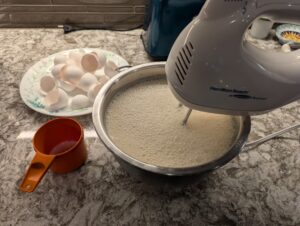
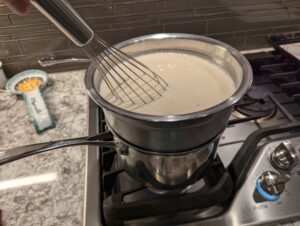
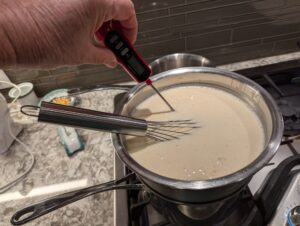
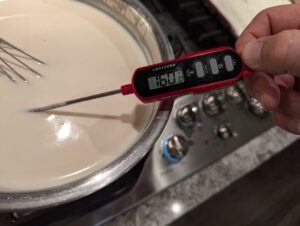
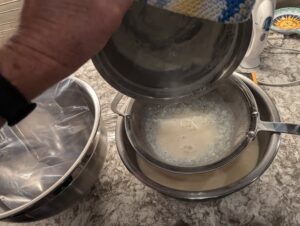
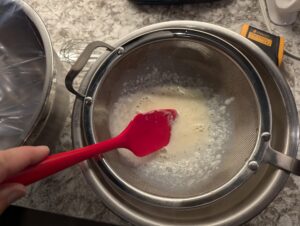
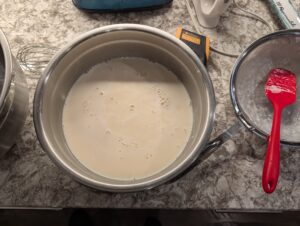
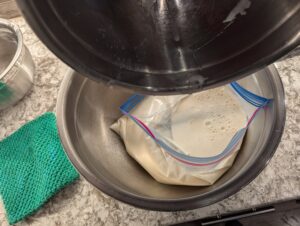
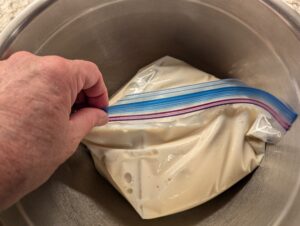
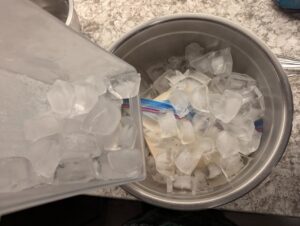
Beat 2 whole eggs and 1 cup milk in a double boiler, or in a stainless steel bowl sitting on top of a saucepan containing a small amount of boiling water. Whisk mixture continually while heating the mixture to 160 F measured with a digital instant immersion thermometer. Once the milk/egg mixture reaches 160 F, immediately remove from heat and pour through a strainer into another bowl. Use a spatula to clean out the bowl and to push the egg/milk mixture through the strainer. Note that there will be some runny partially cooked egg in the bowl and in the strainer. Push the soft portion through the strainer with a spatula. Pour the hot mixture into a Ziplock bag, seal it, and place it into a bowl and cover it with ice so it will cool quickly. Leave it in the ice until it cools to approximately 40 F, easily measured with an IR thermometer. Then pour it into the blender and add the other ingredients as indicated in the recipes and freeze in ice cream machine as usual.
It takes about 5 minutes to break and beat the eggs and the milk, 7 minutes to heat in double boiler to 160 F, 2 minutes to strain it, pour it into a Ziplock bag and put in an ice bath, 35 minutes to cool from 160 F to 40 F, 3 minutes to add the other ingredients and blend in the blender. All together it took 50 minutes from starting to break the eggs to the time it went into the ice cream freezer.
You can do this milk/egg preparation ahead of time just like prepping fruit or nuts, and keep it in the refrigerator for up to 2-3 days until you are ready for it.
If you make enough for multiple batches of ice cream, the amount of the pasteurized milk/egg mixture equivalent to 1 cup milk and 2 eggs is 320 g.
References
- 1. USDA Food Safety and Inspection Service “Shell Eggs from Farm to Table” under the heading “Who is at risk for eating raw or undercooked eggs?” https://www.fsis.usda.gov/food-safety/safe-food-handling-and-preparation/eggs/shell-eggs-farm-table
- 2. USDA Food Safety and Inspection Service “Shell Eggs from Farm to Table” under the heading “Use Safe Egg Recipes” https://www.fsis.usda.gov/food-safety/safe-food-handling-and-preparation/eggs/shell-eggs-farm-table