
Just getting started making ice cream? The main thing you need is an ice cream machine.
As an Amazon Associate I earn from qualifying purchases.
Any kind of ice cream machine will work. My favorite is the Cuisinart 21 ice cream maker. Read my tip on Ice Cream Machines for more details!
Besides the ice cream machine, if you have a well-stocked kitchen you likely already have most of the other kitchen supplies you will need. A few of these are essential, but others are just nice to have or make ice cream making easier. Don’t feel like you need to go out and buy any or all of these. I just list them here along with photos to let you know what they look like and what they are used for. And unless otherwise stated, none of these are meant to be product endorsements, these are just the supplies that we use.
- Blender
- Cardboard Storage Containers
- Cutting Board and Butcher Knife
- Digital IR thermometer
- Digital Kitchen Scale
- Double Boiler
- Electric Mixer
- Freezer
- Glass Dishes
- Hot Pads
- Instant Read Digital Immersion Thermometer
- Juicer
- Measuring Spoons and Cups
- Paper Towels
- Portable Refractometer
- Potato Masher
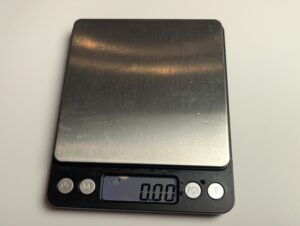
- Precision Digital Scale
- Printable Labels
- Rolling Pin
- Rubber Mallet
- Silicone Mat and Cookie Sheet
- Small Metal Frosting Spatula
- Small Silicone Spatula
- Strainer
- Timer
- Waffle Bowl Form
- Waffle Cone Iron
- Wire Whisk
- Zester
- Ziplock Bags
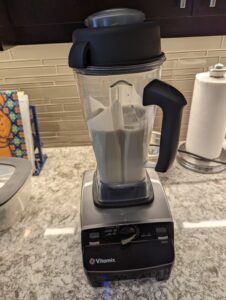
Blender
You use the blender to get the emulsifier contained in the eggs to bind to both the fat molecules in the milk and cream and to the water molecules in the fruit, milk, and other watery ingredients. that is essential to keep the water from separating out and freezing into lumps of ice or ice crystals. Any kind of blender will work. As noted in the recipes, you blend many, but not all, of the ingredients on High for a minute. Afterwards you add the whipping cream and blend it on Medium for 30 seconds. If you beat the whipping cream on High, or on Medium for too long a time, it will churn into butter and you will have lumps of butter throughout your ice cream.
Cardboard Storage Containers
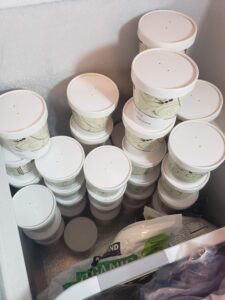
You can store your finished ice cream in any container you want that has a lid, including glass, plastic, cardboard, etc. I like using cardboard containers with lids because it makes it easy to give away ice cream to friends without needing to get the dishes back, and because cardboard containers are inexpensive, light weight, stack well, and don’t get brittle when they are cold. Plastic containers work too, but most plastics get brittle when they are cold. If you use too much force trying to scoop out frozen ice cream, the brittle plastic can shatter leaving shards of plastic in your ice cream and on your counter.
Here are the kind of cardboard containers we use. Click here for link on Amazon. Or, I can often get them cheaper here at Webstaurant.
Cutting Board and Butcher Knife
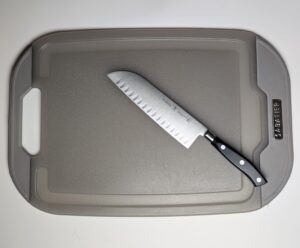
Use when chopping nuts, chocolate, cutting fruit, etc.
Digital IR thermometer
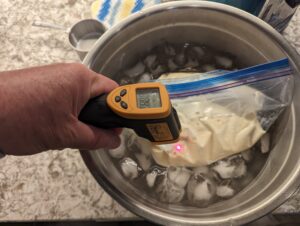
An IR thermometer is inexpensive and very handy for measuring temperatures without having to insert a thermometer. For example, I use it to monitor the temperature of my milk/egg mixture when I am pasteurizing it until it is close to 160F. I use it later to check the temperature of the milk/egg mixture after it has been in an ice bath for some time, since I can just point it at the Ziplock bag rather than having to insert it into the mix. I use it to measure the temperature of my caramel or butterscotch while they are cooking since inserting an immersion thermometer or candy thermometer interferes with whisking the ingredients or can sauce the caramel to sugar. I use it to check the temperature of my chest freezer to find the coldest spot for my ice cream tubs. This Etekcity Infrared Thermometer Laser Temperature Gun 1080 has a temperature range of -58°F~ 1130°F and is available on Amazon.
Digital Kitchen Scale
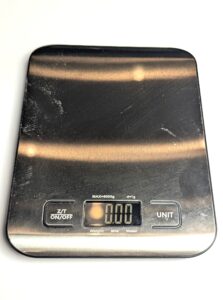
You don’t have to have a kitchen scale to make these recipes, but I find that it makes it much simpler. I have listed the amounts of the ingredients in teaspoons, Tablespoons, cups, etc. in the recipes. I have also listed what that amount is equivalent to in grams. This makes it very easy if you want to change the quantity you are making. For example, if your ice cream machine holds more or less than mine does, measuring ingredients by weight makes it very easy to change the quantities of all of the ingredients to make three quarters, double, triple, or other multiples of the recipe. A scale also comes in handy if you are making several batches of the same flavor and have made prepped some of the ingredients ahead of time, to then separate them back out into enough for each batch. I do this when prepping the fruit, cookies, caramel, nuts, egg/milk mixture, etc.
I like this SOYOK Digital Kitchen Food Scale available on Amazon because it is extremely inexpensive, measures to 1 g but has a capacity of up to 5 Kg (approximately 11 lbs.), it has a Tare Weight function so you can zero out the weight of the bowl holding your ingredients, and the battery lasts a long time.
Double Boiler
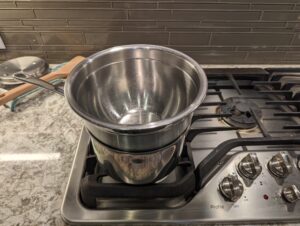
You can use a double boiler to heat the egg/milk mixture. If you don’t have a double boiler you can easily substitute using a metal bowl that rests on top of a saucepan with about a half-inch of water in it. See the Tip Pasteurized Eggs Instruction Sheet.
Electric Mixer
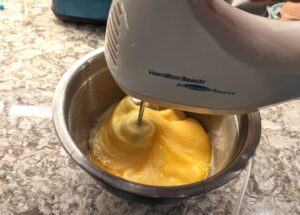
Use to mix eggs well before adding to milk and heating to pasteurize them.
Freezer
You will need some freezer space for your finished ice cream, unless you plan to always eat all of it immediately. You may also need room for ice cube trays to make ice for ice baths to cool the egg/milk mixture, or to store a bag of ice if you use an ice cream freezer that needs ice and rock salt. You may need room for your ice cream tubs if you use a Cuisinart 21 like we do. If you have room in the freezer in your refrigerator that can work. Be aware however that most freezers in refrigerators are frost free. The way they do that is to briefly heat the freezer up above freezing everyday to melt any frost that has accumulated. Repeatedly freezing and defrosting tends to make ice crystals grow in your ice cream.
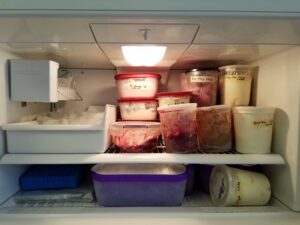
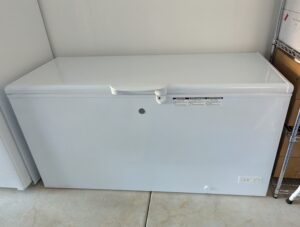
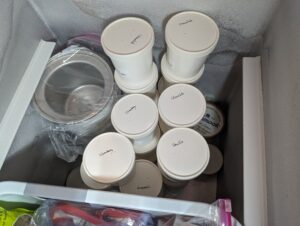
We make a lot of ice cream and we need a place to store it, and I have a number of ice cream tubs that I keep frozen all the time so that I can make ice cream at any time. So, we store both our ice cream and our tubs in a chest freezer in the garage. We purposely bought a manual defrost freezer to avoid having ice crystals grow in our ice cream over time. In addition, the chest freezer gets much colder than the freezer in our refrigerator. The coldest parts of our chest freezer range from -18 F to -24 F, while the coldest parts of the freezer in our refrigerator are 0 F.
Here is a picture of our chest freezer.
Glass Dishes
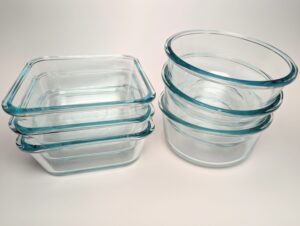
Use microwave and oven safe class dishes to melt chocolate and butter together, to pour hot caramel into, or for storing prepped fruit, nuts, etc.
Hot Pads
Use to keep from burning yourself on hot dishes and pans.
Instant Read Digital Immersion Thermometer
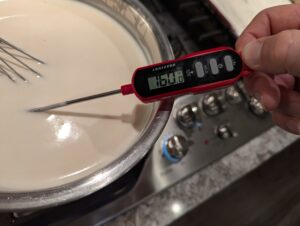
We use this to measure the temperature of the egg/milk mixture once it is close to 160 F. I find it gives a more reliable temperature of the mixture in the middle and near the bottom of the pan, as opposed to the IR thermometer which only sees the top surface of the mixture. Since the eggs in the mixture are starting to cook at 160 F, and since you want to remove the mixture from the stove as soon as it reaches 160 F, an accurate, rapid temperature measurement is fairly critical. I like this Lonicera Digital Cooking Thermometer available on Amazon because it responds quickly, has a backlight and is easy to read, and is inexpensive.
Juicer
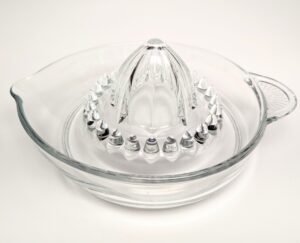
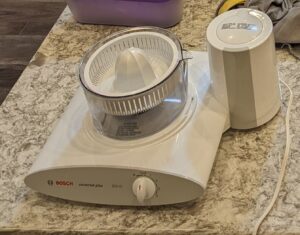
We use a juicer to juice lemons, oranges, limes, etc. We have two juicers. We use a small hand juicer if we are only making one batch of ice cream. If we are making multiple batches of the same kind of ice cream, the juicer attachment on our Bosch mixer saves a lot of time and effort.
Measuring Spoons and Cups
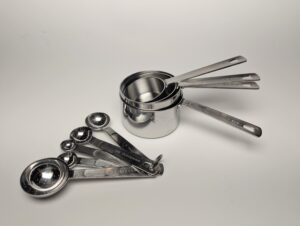
Use to measure the correct amount of ingredients. Any measuring spoon or cup set works fine. See the note about also using a Digital Kitchen Scale.
Paper Towels
Use to wipe rim of cardboard storage containers after filling them. Also to clean up messes.
Portable Refractometer
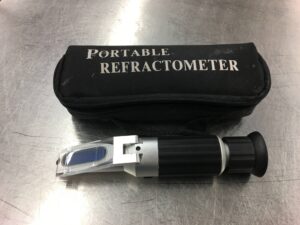
All of the recipes include the correct amount of sugar to add to the fruit in ice cream. However, sometimes the fruit you buy is sweeter than other times, or maybe you want to make ice cream with a fruit not listed in our recipes. A Portable Refractometer is an inexpensive instrument you can use to determine the sugar content of fruit and then calculate how much more sugar to add to get to the desired 25%. See the Tip on Calculating Sugar to Add to Fruit.
I like this Portable Refractometer available on Amazon. (If you buy one, be sure you get the one for measuring sugar content, with a range of 0% to 32%, as there are other refractometers from the same company that look identical but are used to measure salinity, beer, honey, urine, etc., or that have a different range of sugar content)
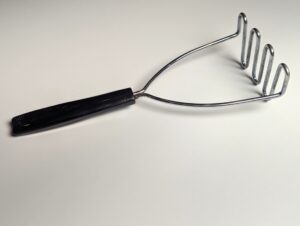
Potato Masher
Use this to mash fruit for ice cream. You can use a fork to mash fruit but this gets tiring, especially if you are doing a lot of fruit. If you try to blend fruit in the blender it all turns into juice, which is not what you want. You want to have both fruit juice and pulp. You stain the juice from the pulp and add the juice to the other ice cream ingredients before it is frozen. This gives the ice cream flavor. You wait and add the fruit pulp after the ice cream is frozen, to give “Mouth feel”, meaning the texture and recognition of lumps of fruit.
Precision Digital Scale
You probably won’t use this very often. It measures in hundredths of a gram, and I only use it when I need to measure very small quantities of ingredients, such as a few grams of citric acid, or a few drops of an intense flavoring. I like this AMIR Digital Precision Scale available on Amazon. It is very inexpensive, can measure up to 500 g (about 1 lb.) in 0.01 g increments, is backlit, and the battery lasts a long time. Be sure to not put anything heavy on it, it is only for very light loads.
Printable Labels
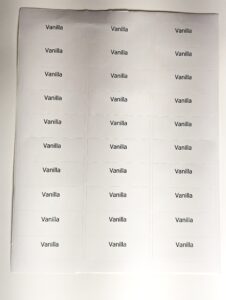
You don’t need to label ice cream if you only make a single batch and it is just for yourself. However, if you are going to give some away, or have several flavors of ice cream in the freezer, it is nice to label them. You can just write the flavor on a piece of freezer tape or on the lid of a cardboard container. We make a lot of ice cream, so I buy sheets of printable peel off labels and print a sheet for each of the flavors I make. That makes it very neat and saves a lot of time labeling the containers. I like these Printable Labels available from Amazon. I print them with my laser printer so the ink doesn’t run when the label gets wet or icy. They are 1″ x 2-5/8″ and can be printed in Word under Mailing, labels.
Rolling Pin
Use to mash cookies, Oreos, etc. contained in Ziplock bags into crumbs.
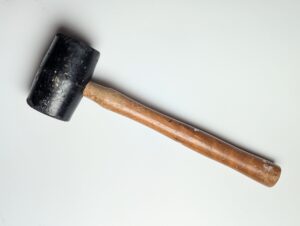
Rubber Mallet
Use to break candy canes, butterscotch, and other hard candies contained in Ziplock bags into small pieces. Be sure to do this on a concrete floor or other surface that will not be damaged by hitting it.
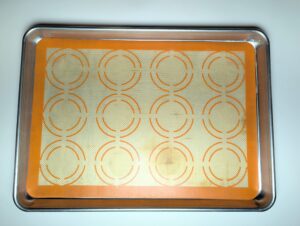
Silicone Mat and Cookie Sheet
Use silicone mats in cookie sheets when roasting nuts, heating raw flour, to pour out hot butterscotch to cool, to pour out hot chocolate/butter mix to cool, or to help in rolling waffle cones. Using a silicone mat eliminates most of the difficulty with clean up. It also makes it much easier to remove the cooled butterscotch or chocolate from the cookie sheet.
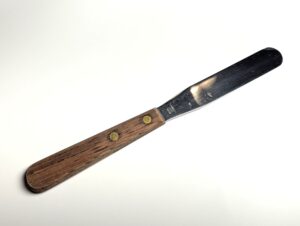
Small Metal Frosting Spatula
These are used to smooth the top of the ice cream after you have put the finished ice cream into containers.
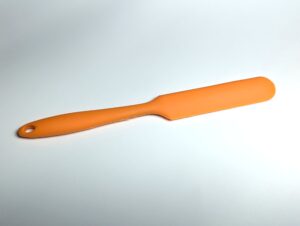
Small Silicone Spatula
These are very useful for scooping ice cream that has come up over the top of the dasher back into the tub, for cleaning ice cream off of the dasher, and for scraping ice cream off the inside of the tub without damaging the soft aluminum tub wall. These narrow Silicone Spatulas are available on Amazon.
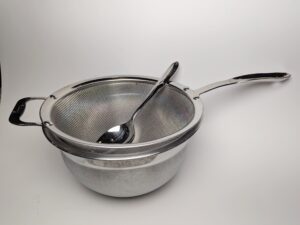
Strainer
Use a fine strainer and a large heavy spoon or spatula to separate fruit juice from fruit pulp, or to remove small fruit seeds.
Timer
Use the timer on your phone or a digital timer to measure the amount of time you are blending ingredients, how long the ice cream has been in your ice cream machine, etc.
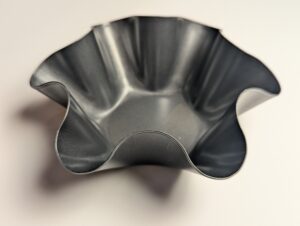
Waffle Bowl Form
We love these Non-Stick Fluted Tortilla Shell Pans available on Amazon. Simply make a waffle using the Waffle Cone Iron and drop it into this form, and you have a delicious waffle bowl for your ice cream.
Waffle Cone Iron
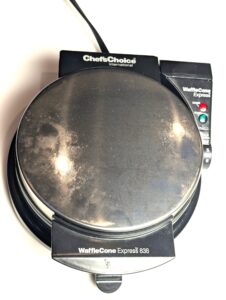
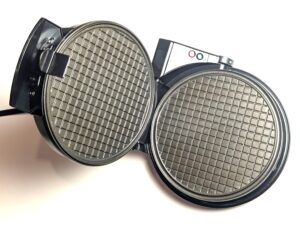
I use this Chef’sChoice WaffleCone Express 838 Ice Cream Cone Maker, available on Amazon, to make waffle cones or waffle bowls.
Wire Whisk
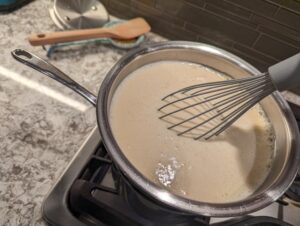
Use a small wire whisk to whisk together chocolate and butter after melting them in the microwave. Use a large wire whisk to continually whisk the milk and eggs while heating them.
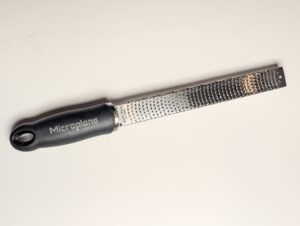
Zester
Use to remove zest (outer peel) from limes, lemons, oranges, etc. This is much easier than the fine teeth on a grater, and you are much less likely to scrape yourself. I like this Microplane Zester available on Amazon. See the Tip on Zesting Lemons
Ziplock Bags
Use to immerse hot egg/milk mixture in ice bath. Also to hold cookies, candy canes, butterscotch, Oreos, or other items that will be mashed into crumbs.