All ice creams contain sugar. Some recipes call for honey, corn syrup, sweetened condensed milk, brown sugar, or other sweeteners. We use white granulated sugar in most of our recipes. Honey can add a nice taste to some recipes. A small amount of corn syrup can help lower freezing temperature without making the ice cream taste too sweet, but adding lots of corn syrup makes the ice cream taste like corn syrup and makes it taste cheap and fake.
The sugar in ice cream is not primarily to make it sweet, but to lower the freezing temperature of the ice cream so that it doesn’t taste rock hard like an ice cube. The sugar content of the ice cream should be 25%. The amount of sugar in the base mix recipe makes the base mix 25% sugar. When adding fruit or fruit juice, the fruit may already contain anywhere from about 4% to 30% sugar, depending on the kind of fruit and how ripe it is. The recipes list the approximate amount of sugar to add to the fruit to bring its sugar content to 25%. However, some strawberries, lemons, blackberries, peaches, etc. are sweeter than others.
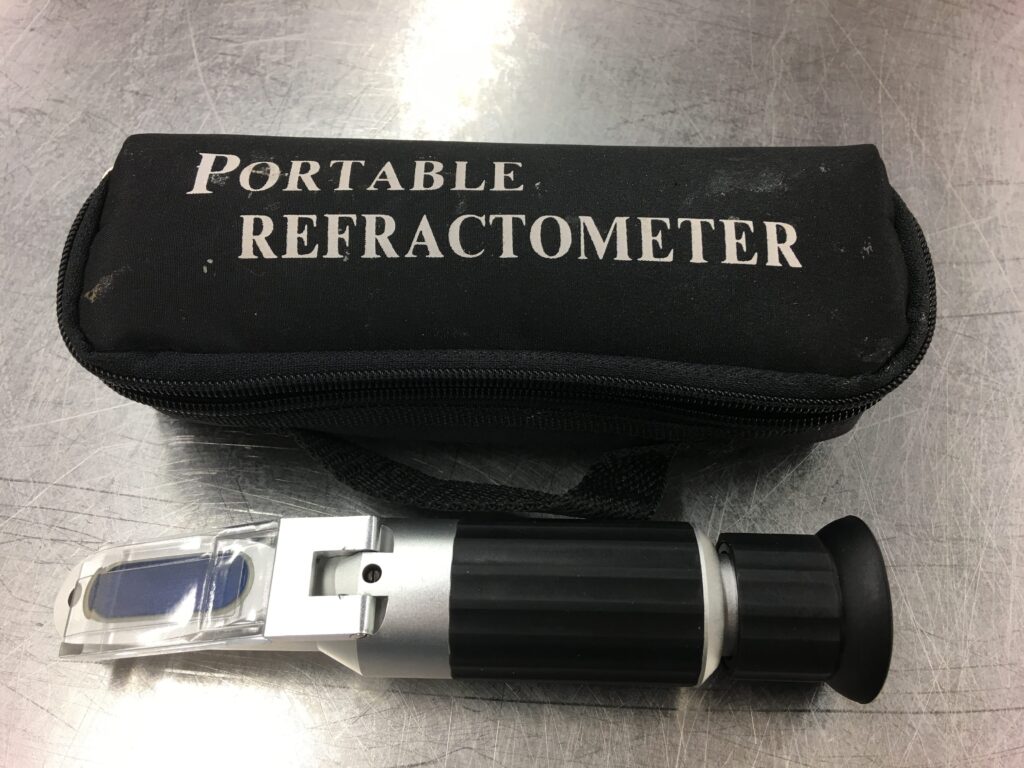
As an Amazon Associate I earn from qualifying purchases. If you want to measure the sugar content precisely, we use a Portable Refractometer. (If you buy one, be sure you get the one for measuring sugar content, with a range of 0% to 32%, as there are other refractometers from the same company that look identical but are used to measure salinity, beer, honey, urine, etc.)
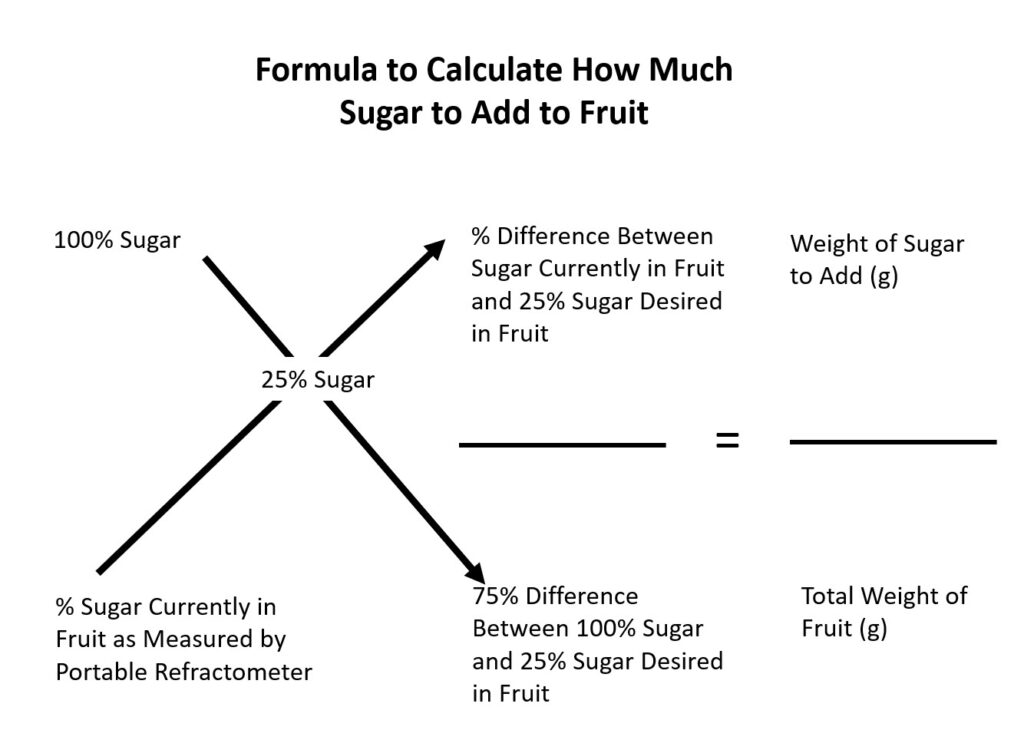
Mash the fruit, then put a drop of juice from the mashed fruit onto the refractometer. It will tell you what percent sugar is already in the fruit. Weigh the total amount of fruit you will be adding. Then there is a formula to use to calculate how much additional sugar to add to the fruit.
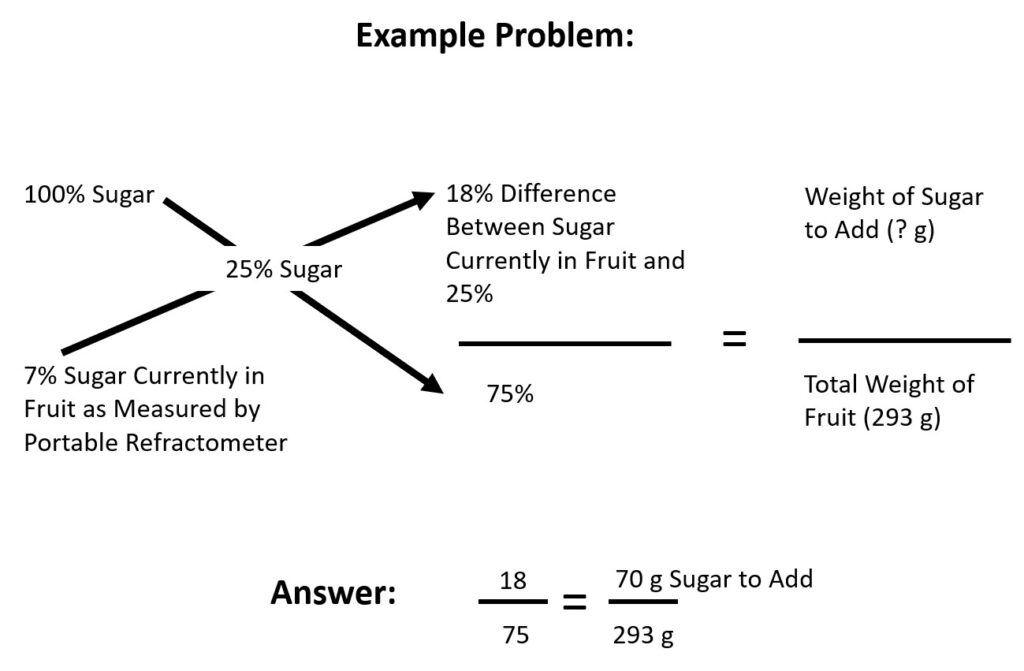
Here is an example of how the calculation works, using numbers from the Fresh Strawberry recipe. The recipe calls for 293 grams of fresh strawberries. When the strawberries were mashed up a drop of the strawberry juice was placed on the refractometer, which measured the sugar content of the strawberries as 18%. We put these numbers into the diagram below. So, the measured % of sugar in the fruit is 18%. The difference between 25% (the desired level of sugar in the fruit) and 18% (the measured amount of sugar naturally in the strawberries as measured by the refractometer) is 7%. The difference between 100% sugar in sugar and 25% (the desired level of sugar in the fruit) is 75%. So we write that the ratio of 18% over 75% is equal to the ratio of X grams of sugar to add to the fruit over the 293 total grams of fruit. To solve for the “X grams of sugar to add to the fruit”, we cross multiply. 18% times 293 grams of fruit divided by 75% = X grams of sugar to add to the fruit, which comes out to 70 grams. This is the amount shown in the Fresh Strawberry ice cream recipe. If this particular batch of strawberries had been less ripe, with a sugar content of say 14%, or very sweet and ripe with a sugar content of say 24%, then this formula would tell us how much more or less sugar to add to the fruit.
While all of our recipes list the amount of sugar to add, the refractometer can be very helpful if you are making up a new recipe and don’t know how much sugar to add for the fruit. For example, if you decided to make papaya ice cream, or dragon fruit, kiwi, sour sop, avocado, or any other fruit where you didn’t know what its natural sugar content is.